

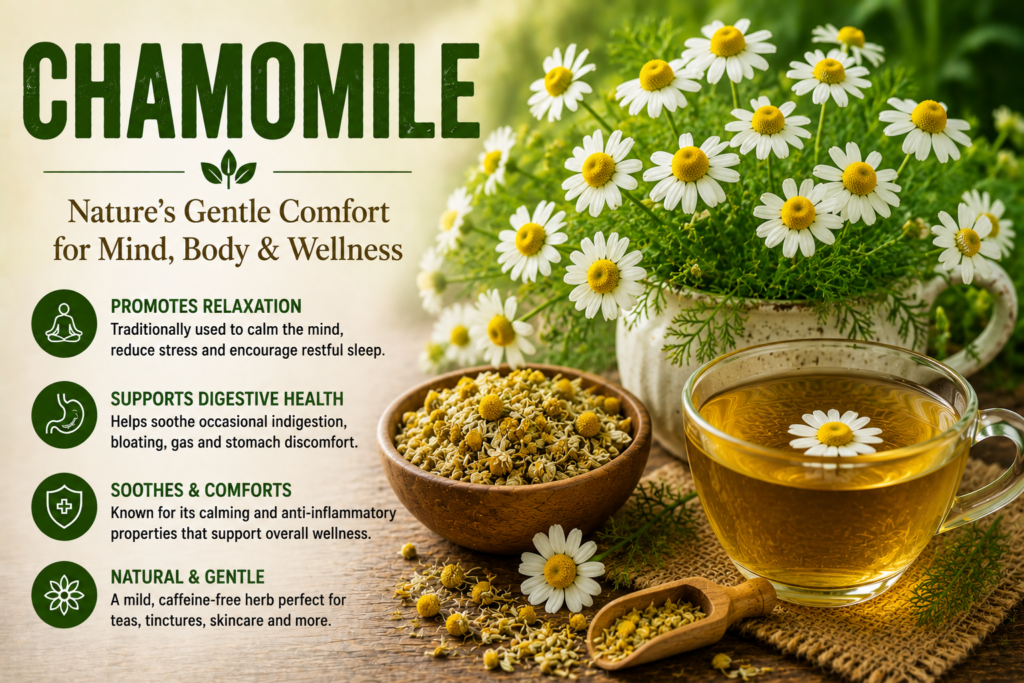
Matricaria chamomilla (also known as Matricaria recutita) — German chamomile
We may earn a commission from qualifying purchases at no additional cost to you.
Description
General safety considerations:
- Chamomile is generally well tolerated by many people when used in foods/teas and in properly formulated topical products.
- However, safety can vary by individual sensitivity and by product type.
Uncertainty flag: Specific medical safety guidance depends on pregnancy/lactation status, age, health conditions, and the exact product (tea vs. extract vs. tincture). Consult a clinician for personalized guidance if you have risk factors.
Other Common Names
Chamomile; German chamomile; Roman chamomile
Medicinal Uses
German chamomile has traditional uses for minor gastrointestinal discomfort, including bloating and minor spasms. EMA also recognizes certain preparations for traditional use in minor skin and mouth conditions. These uses are based on long-standing experience rather than sufficient clinical trial evidence.
Preliminary research suggests some chamomile supplements may help generalized anxiety disorder, but this does not establish the same benefit for tea. Evidence for treating insomnia is very limited.
Tea, extracts, and topical products have different intended uses and should not be treated as interchangeable.
Dosage and Administration
German chamomile tea, extracts, tinctures, and topical products differ in strength and intended use. There is no single dose that applies to every preparation.
- Tea: follow the packaged product’s preparation and serving instructions.
- Extracts or tinctures: follow the specific product directions. Do not substitute tea measurements for concentrated products.
- Topical products: use only as directed for skin application and avoid the eye area. Do not apply a product if you are allergic to chamomile or related plants.
- Seek professional guidance before medicinal use during pregnancy or breastfeeding, in children, or alongside medication.
If symptoms persist for more than one week during treatment, consult a healthcare professional.
Common Preparations
- German chamomile tea: an infusion made from dried flower heads.
- Extracts and tinctures: concentrated preparations whose ingredients and strength vary by product.
- Topical products: creams or ointments formulated for application to the skin.
Products intended for skin use should not be swallowed. Homemade tea is not equivalent to the extracts used in clinical research.
German chamomile (Matricaria chamomilla, also known as Matricaria recutita) is used in herbal tea, extracts, and topical products. It has traditional uses for minor digestive and skin complaints, but reliable clinical evidence remains limited. Preliminary research on some supplements suggests possible benefits for anxiety; evidence for treating insomnia is very limited.
Preparations differ in strength and intended use. Chamomile can cause allergic reactions and interact with medicines. Ask a healthcare professional before medicinal use if you take medication, are pregnant or breastfeeding, or have relevant allergies.
Evidence Summary
Reliable clinical evidence is insufficient to establish chamomile’s effectiveness for most promoted health uses.
- Anxiety: preliminary studies suggest some German chamomile supplements may help generalized anxiety disorder, but these findings do not establish the same benefit for tea.
- Sleep: research on insomnia is very limited, and chamomile is not an established treatment.
- Digestive and skin complaints: EMA recognizes certain German chamomile flower preparations for traditional use, including minor bloating, spasms, and some minor skin conditions. This recognition rests on long-standing use rather than sufficient clinical trial evidence.
Free Herbal Remedies Toolkit
Get practical herb references, tea ideas, safety notes, and printable tracking pages.
Results from specific extracts or multi-herb products should not be assumed to apply to homemade chamomile tea.
Safety Considerations
- German chamomile is generally considered safe in amounts commonly found in tea and foods, but allergic reactions can occur.
- Allergy risk is higher in people allergic to related plants, including ragweed, chrysanthemums, marigolds, and daisies. Reactions can sometimes be severe.
- If you take medication, consult a pharmacist or clinician before medicinal use. Reported and possible interactions require product-specific assessment.
- Seek professional advice before use if you have an estrogen-sensitive condition or use hormonal contraception.
- Safety during pregnancy and breastfeeding is not well established. Consult your healthcare provider before use.
- Avoid applying chamomile near the eyes because it may cause irritation.
- Stop use if a reaction develops. Difficulty breathing or swelling of the lips, tongue, or throat requires emergency care.
Possible Side Effects
Side effects of German chamomile are uncommon but may include:
- Nausea
- Dizziness
- Allergic reactions, which can sometimes be severe
- Eye irritation if used near the eyes
Allergic reactions are more likely in people allergic to related plants such as ragweed, chrysanthemums, marigolds, or daisies. Stop use if a reaction occurs. Seek emergency care for difficulty breathing or swelling of the lips, tongue, or throat.
Interactions & Contraindications
Interactions have been reported between chamomile and warfarin, as well as some medicines processed by the liver. Possible interactions with sedatives are based on theoretical concerns rather than established clinical evidence.
Preliminary evidence also raises concerns about interactions with hormonal birth control and possible effects on estrogen-sensitive conditions.
If you take medication or have an estrogen-sensitive condition, ask a pharmacist or clinician before medicinal use. Provide the product label and your medication list. Do not stop or change prescribed treatment yourself.
Do not use chamomile preparations if you have a known allergy to chamomile or related Asteraceae plants.
Who Should Avoid It
- People allergic to chamomile or related Asteraceae plants, including ragweed, daisies, chrysanthemums, and marigolds, should avoid chamomile preparations.
- People who are pregnant or breastfeeding should seek professional advice before use because safety information is limited.
- People taking warfarin, sedatives, hormonal contraceptives, or other medicines should ask a pharmacist or clinician about possible interactions before medicinal use.
- People with estrogen-sensitive conditions should seek professional advice before use.
- Children should receive medicinal chamomile products only with age-appropriate professional guidance. Tea, tinctures, and concentrated extracts are not interchangeable.
Frequently Asked Questions
How do I choose German vs. Roman chamomile?
German chamomile and Roman chamomile are different species. This article covers German chamomile (Matricaria chamomilla, also called Matricaria recutita). Check the botanical name on the product; evidence and safety guidance should not automatically be transferred between species.
Can chamomile help with sleep?
Chamomile is commonly enjoyed as a bedtime tea, but research on insomnia is very limited. It is not an established treatment for insomnia, and findings from specific extracts do not prove that tea has the same effects.
Is chamomile safe for everyone?
Not everyone. People with allergies to Asteraceae/daisy family plants should avoid chamomile. If you have pregnancy/nursing concerns or chronic conditions/medications, consult a clinician before regular medicinal use.
What’s the best way to use chamomile for minor skin irritation?
If you choose a chamomile topical product, use one intended for skin and follow its directions. Avoid it if you are allergic to chamomile or related daisy-family plants, and keep it away from the eyes. Stop if irritation develops and seek medical advice if symptoms persist or worsen.
Can I use chamomile while taking medications?
Ask a pharmacist or clinician before medicinal use. Interactions with warfarin and some medicines processed by the liver have been reported; interactions with sedatives are also possible. Provide the product label and your medication list so they can assess your circumstances.
Sources
National Center for Complementary and Integrative Health (NCCIH). Chamomile: Usefulness and Safety. https://www.nccih.nih.gov/health/chamomile
European Medicines Agency (EMA). Matricariae flos — Matricaria flower (Matricaria recutita). https://www.ema.europa.eu/en/medicines/herbal/matricariae-flos
References & Sources
Trusted sources used to support this article.