

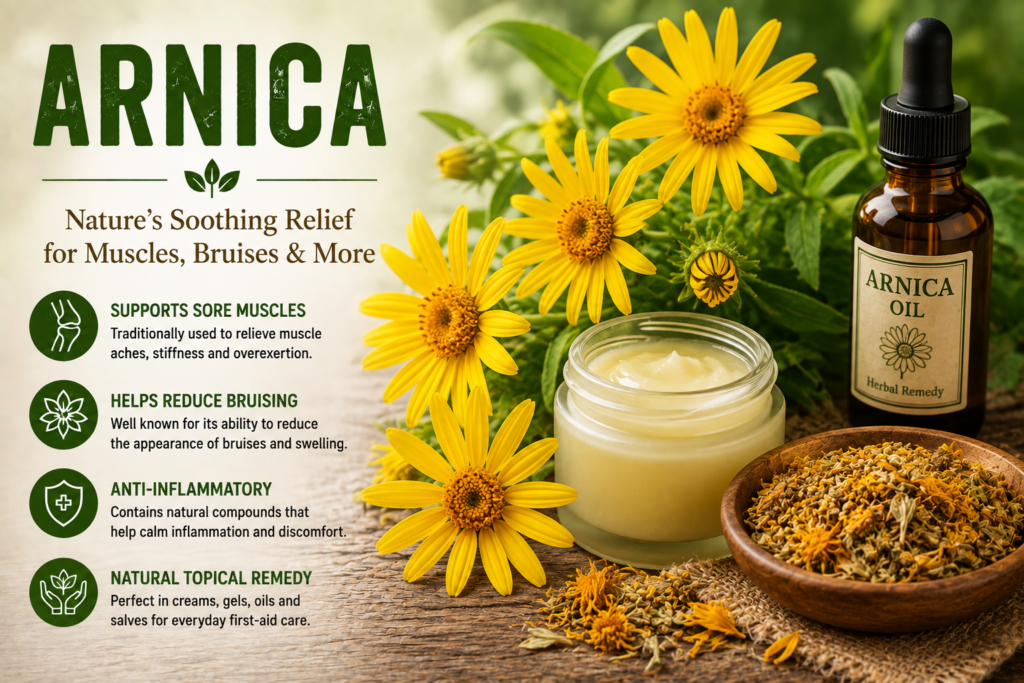
Arnica montana (commonly referenced); other Arnica species may be used in products (unspecified products should be checked on the label).
Description
Arnica is a perennial plant with yellow flowers. In traditional and modern consumer products, “arnica” is usually prepared as an extract (often alcohol-based tinctures that are diluted for topical use), or formulated into topical gels/creams.
Note: There are multiple Arnica species and multiple product types. Safety and appropriate use can differ by formulation and concentration, so rely on the specific product’s label instructions.
Other Common Names
Arnica, mountain arnica
Medicinal Uses
Common traditional/home uses include:
- Temporary relief of bruising
- Temporary relief of muscle aches/soreness (topical)
Evidence-aware note: Some studies of topical arnica exist for pain-related conditions, but overall findings can vary by product type, concentration, and study design. This profile is educational and does not guarantee effectiveness for any individual.
Dosage and Administration
Typical home use (topical) is product-dependent. As a general approach:
- Apply only as directed on the specific topical product label (gel/cream/ointment).
- Use on intact skin; avoid broken skin.
- Use a small amount and stop if irritation occurs.
Uncertainty flag: Because arnica tinctures and extracts vary widely in concentration, there is no single safe “home dosage” that applies to all forms. Do not improvise dosing from tinctures unless you have clear, label-approved dilution instructions.
Common Preparations
Common preparations include:
- Topical gels/creams/ointments containing arnica extract
- Diluted arnica tinctures for external application (only if the product provides dilution guidance for skin use)
- Homeopathic arnica (highly diluted; directions vary by product)
Uncertainty flag: Product ingredients and concentrations vary by manufacturer—check the label for species, extract type, and intended route (external vs oral).
Arnica refers to several closely related plants in the Asteraceae family, commonly used in topical forms for bruising and muscle soreness. In herbal and home remedy contexts, products are typically made from Arnica montana or related Arnica species, and are used externally (on intact skin) in diluted preparations such as gels, creams, or diluted tinctures.
Important caution: Arnica preparations taken by mouth can be dangerous. Do not ingest unless a qualified clinician specifically directs it for a specific product and situation. Many arnica products sold for topical use are designed for external application only.
Because “arnica” is also used in homeopathy and in commercial topical formulations, the safest approach is to follow the product label carefully (especially directions and warnings) and to avoid using arnica on broken skin, open wounds, or near eyes/mucous membranes.
Evidence Summary
Evidence is mixed and depends on the exact condition and formulation. Many consumer topical products are designed for external use, and some research has explored topical arnica for bruising and musculoskeletal discomfort.
Uncertainty flag: Effectiveness cannot be guaranteed, and results may not translate across different arnica species, extraction methods, and product concentrations.
Safety Considerations
Caution is essential.
- Do not take arnica by mouth unless a clinician instructs you to use a specific product for that purpose.
- Avoid applying to broken skin, open wounds, or near eyes/mucous membranes.
- Use only on intact skin and discontinue if irritation develops.
- Keep out of reach of children.
If pregnant/breastfeeding, using in children, or using while on medications or with chronic conditions: consult a qualified healthcare professional before using, especially for anything beyond standard topical label directions.
Possible Side Effects
Possible side effects (topical):
- Skin irritation, redness, or contact dermatitis
- Burning/stinging at application site
Uncertainty flag: Frequency and severity depend on the product type and concentration.
Interactions & Contraindications
Interaction risk depends on whether arnica is used orally vs topically and on the specific product and person.
Uncertainty flag: Because this profile does not have verified interaction data for every arnica formulation, treat potential interaction risk as possible—especially with oral use. For topical-only use, interaction risk is generally lower, but irritation or sensitivity can still occur.
Who Should Avoid It
Avoid:
- Oral ingestion of arnica extracts unless explicitly directed by a clinician
- Use on broken skin or large areas of injured skin
- Application to eyes, inside mouth, or other mucous membranes
- Using multiple products with similar actives simultaneously on the same area without guidance
Also avoid using if you have known sensitivity to arnica or related Asteraceae plants (e.g., ragweed/daisy family), unless advised by a clinician.
Frequently Asked Questions
What is arnica used for?
Mostly for temporary relief of bruising and muscle soreness when used externally (topical) as directed on the product label.
Is arnica safe to take by mouth?
Do not ingest arnica products unless a qualified clinician specifically directs it. Ingestion can be dangerous.
Can I apply arnica to broken skin?
Avoid. Use only on intact skin, because broken skin increases irritation and absorption risk.
What form of arnica is best?
Look for reputable topical gels/creams/ointments that clearly list arnica extract and provide external-use instructions.
How do I know I’m using the right product?
Check the label for arnica species (when listed), concentration/ingredients, and clear “external use” directions.
Can arnica be used on children?
Consult a healthcare professional first—pediatric guidance can differ and product directions must be followed exactly.
What should I do if arnica irritates my skin?
Stop using it and rinse the area if needed. Seek medical advice if irritation is severe or persists.
Sources
Recommended verifiable resources (non-exhaustive):
- National Center for Complementary and Integrative Health (NCCIH): guidance on complementary health approaches and safety considerations.
- MedlinePlus (U.S. National Library of Medicine): reference entries on arnica (if available) and general safety cautions for herbal products.
- U.S. FDA consumer updates on herbal product safety and “look for” labeling practices.
- Manufacturer’s product label/pack insert for topical arnica formulations (species, intended use, concentration, warnings).
Note: For any ingestion concerns, rely on clinician advice and official medical guidance; avoid relying on unverified online dosing claims.