

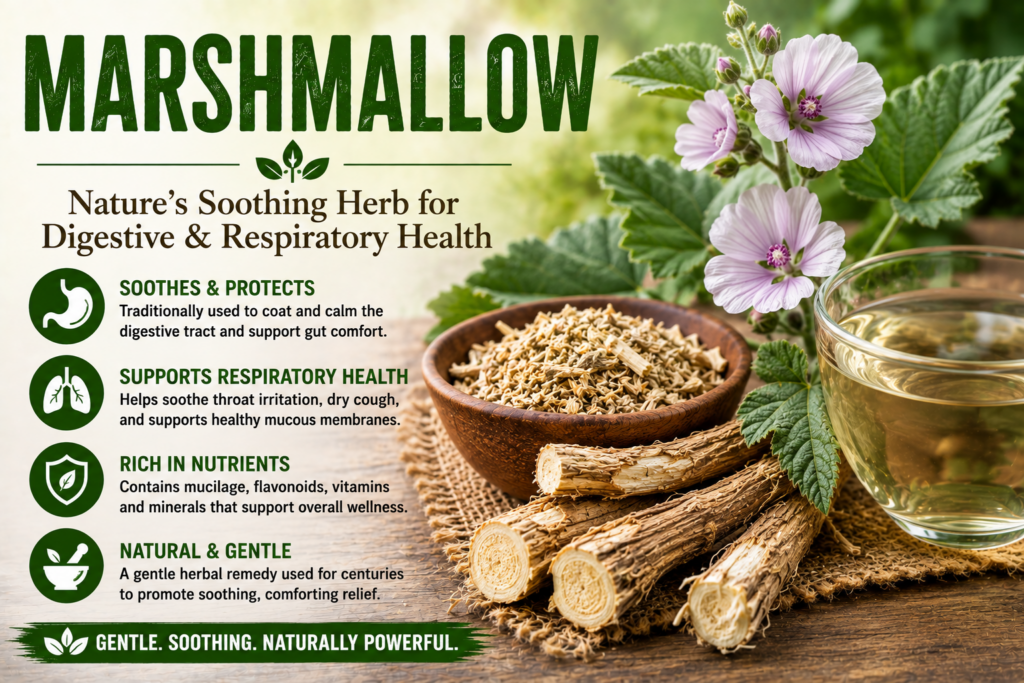
Althaea officinalis
Description
*Althaea officinalis* is a perennial plant in the mallow family (Malvaceae). The root is widely used in herbal medicine, largely because it contains mucilage that can form a soothing, gel-like substance when prepared properly. (Note: the marshmallow candy is unrelated as a reliable medicinal substitute—confection ingredients differ.)
Other Common Names
Marshmallow (herb); Marshmallow root
Medicinal Uses
Traditional/commonly used for:
- Soothing minor throat irritation and dry, non-specific cough (symptom-focused)
- Supporting comfort for mild digestive irritation
- Soothing irritation in the mouth (e.g., mild mucosal discomfort)
Uncertain/varies by source:
- Specific effectiveness for coughs caused by infections or chronic conditions is not uniform across references and depends on preparation and patient context.
Not for treating:
- The underlying cause of severe or persistent symptoms.
Dosage and Administration
General guidance (label-based):
- Follow the product’s dosing instructions for teas, extracts, or lozenges.
Home preparation note (uncertainty):
- Traditional methods often involve soaking/simmering the root to extract mucilage, but exact ratios and methods vary widely by tradition and recipe.
- Because preparations can differ substantially, avoid assuming that one kitchen recipe equals the potency of a commercial product.
Do not use as a substitute for medical care when symptoms are severe, persistent, or worsening.
Common Preparations
Common preparation types:
- Tea/infusion from marshmallow root
- Syrups
- Lozenges
- Tinctures/extracts (varies by manufacturer)
Preparation considerations:
- Mucilage-based preparations are often used for soothing/demulcent effects.
- Extract/tincture preparations may have different constituents depending on solvent and processing (efficacy may differ).
Quality considerations:
- Prefer reputable suppliers with clear labeling of plant part and standardization (if applicable).
Marshmallow refers most commonly to the medicinal plant *Althaea officinalis* (not the sweet marshmallow confection). It’s traditionally used as a soothing demulcent—meaning it may help coat and calm irritated mucous membranes in the mouth, throat, and gastrointestinal tract. Many of its traditional uses center on dry cough, minor throat irritation, and digestive discomfort. Evidence varies by condition and preparation, so treat claims as educational and traditional unless supported by reputable references.
What to look for in a product
– Plant part: root is commonly used for herbal preparations (often labeled as “marshmallow root”).
– Form: tea, tincture/extract, lozenges, or syrups—each can differ in constituent profile.
– Standardization: check for reputable brands and clear labeling (plant part, dosing instructions, and quality testing).
How it’s thought to work (general, not guaranteed)
– Demulcent activity: mucilage (a gel-forming fiber) can form a soothing layer over tissues.
– This may be more relevant to symptomatic relief than to treating the underlying cause.
Evidence Summary
Evidence-aware summary:
- Marshmallow is widely recognized as a demulcent/soothing herb, and this is consistent across traditional use and many herbal references.
- The strength of clinical evidence for specific outcomes (e.g., particular cough conditions) can vary by study quality, preparation type, and endpoints.
- If you’re using it for a persistent cough or digestive issue, consider evidence-backed evaluation by a clinician rather than relying solely on traditional use.
Safety Considerations
Caution and general safety approach (do not treat as a guarantee):
- Use according to label directions or reputable herbal guidance.
- Because “natural” products can still cause adverse reactions, discontinue use if you develop intolerance.
- If you are pregnant, breastfeeding, giving to a child, or have chronic disease, consult a qualified clinician before use.
This profile avoids absolute claims because individual tolerability and product quality vary.
Possible Side Effects
Possible but not definitively guaranteed:
- Mild gastrointestinal upset may occur with some herbal preparations.
- Allergic reactions are possible with any plant product, especially in people with mallow-family sensitivities.
If side effects occur:
- Stop the product and seek medical advice if symptoms are significant or persistent.
Interactions & Contraindications
Potential interaction concern (uncertainty):
- Demulcent herbs may theoretically affect absorption of medications by coating the lining of the GI tract.
Practical precaution:
- Consider separating marshmallow intake from prescription medications by a couple of hours (follow clinician/pharmacist advice).
Note: Specific, well-documented interactions are not listed here because they can depend on product form and are not universally established across sources.
Who Should Avoid It
Avoid or use extra caution if:
- Symptoms are severe (e.g., high fever, shortness of breath, coughing blood)
- Symptoms persist beyond a short period or are recurrent
- You have known allergies to plants in the mallow family (Malvaceae)
- Pregnancy/breastfeeding or pediatric use without professional guidance
Also avoid substituting marshmallow candy for the herb—candy ingredients are not the same as medicinal marshmallow preparations.
Frequently Asked Questions
What’s the difference between marshmallow herb and marshmallow candy?
Marshmallow herb typically refers to *Althaea officinalis* (often marshmallow root) used as a demulcent. Marshmallow candy is a confection made from different ingredients and is not a reliable substitute.
How does marshmallow help a sore throat or dry cough?
It’s traditionally used as a demulcent: mucilage may help soothe irritated mucous membranes. This is symptom-focused and may not address the cause of the cough.
Can I make marshmallow root tea at home?
You can, but traditional recipes vary and potency can differ. For consistency and safety, follow a reputable recipe or use a standardized commercial product.
Is marshmallow safe for children?
Pediatric use should be guided by a clinician or qualified pharmacist, since dosing and safety can vary by age and preparation.
How long should I use it if my symptoms don’t improve?
If symptoms persist, worsen, or are severe, seek medical advice rather than continuing self-treatment.
Sources
Verifiable, non-fabricated places to consult (choose based on your country and access):
- Natural Medicines (professional/patient monographs)
- NCCIH (National Center for Complementary and Integrative Health) — check herb-specific pages (not all herbs are covered)
- European Medicines Agency (EMA) / or national herbal monographs where available (for herbal use/quality information)
- WHO monographs / pharmacopoeia-style references for traditional herbal uses (availability varies)
- Reputable herbal pharmacology references (e.g., British Herbal Compendium or equivalent regional compendia)
Note: I did not include specific study citations or dosing recommendations here because you didn’t request (and I can’t verify) your preferred jurisdiction/product specifics.