

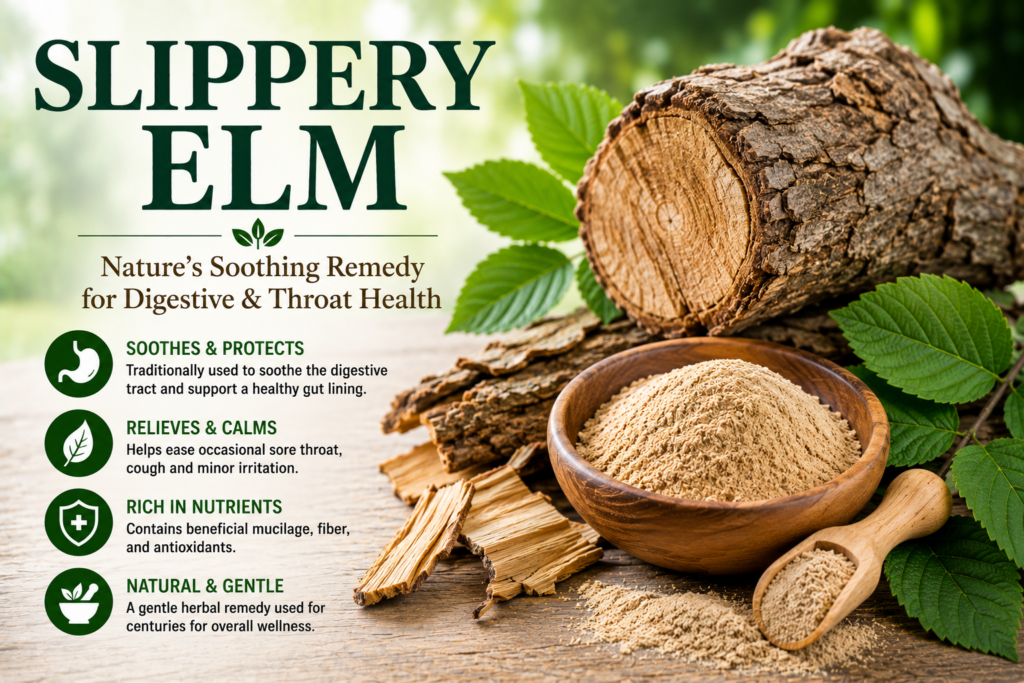
Ulmus rubra
Description
Slippery elm is a tree native to parts of North America. The inner bark is the part used traditionally. When prepared as a powder or tea, it may form a mucilaginous (gel-like) substance that can “coat” tissues.
Quality considerations: Different products can vary in particle size, extraction method, and mucilage content. When possible, choose reputable brands with standardized labeling and clear preparation directions.
Other Common Names
Slippery elm, red elm (note: common name overlaps with other elms in some regions—use the botanical name when possible)
Medicinal Uses
Traditional/demulcent uses include:
- Soothing minor irritation of the throat and mouth
- Supporting comfort related to mild digestive upset
- Traditional use for coughs or hoarseness associated with throat irritation (uncertain—may depend on the cause)
Evidence note: Some use is supported by the mechanism of mucilage (coating/soothing). However, clinical evidence for specific outcomes (and for exact conditions) can be limited or variable. Treat claims as traditional unless backed by high-quality studies for the exact indication.
Dosage and Administration
General educational guidance (do not treat as a prescription):
- Common administration methods include mixing inner bark powder with water to form a mucilage, or using prepared capsules/lozenges per the product label.
- Take with water and follow label directions.
Medication separation (important): Demulcent herbs can reduce absorption of some medicines by forming a coating. Consider separating slippery elm from prescription/OTC medications by at least 2 hours (rule of thumb). If you take multiple medications, confirm timing with a pharmacist or clinician.
If symptoms persist or worsen, stop self-treatment and consult a healthcare professional.
Common Preparations
Common preparations include:
- Powder: Mixed with water to create a gel-like slurry, then taken orally.
- Capsules/tablets: Use product instructions.
- Lozenges: For throat comfort (follow label).
- Tea: Prepared according to label or traditional directions (note that not all products prepare similarly).
Uncertainty note: Preparation details (ratio, simmer time, thickness) vary by brand and tradition, and affect mucilage thickness and user experience.
Slippery elm (Ulmus rubra) is an herb traditionally used for its soothing, demulcent properties—meaning it may help coat and calm irritated tissues in the mouth, throat, and digestive tract. The inner bark is typically processed into powder, capsules, or lozenges. Use caution: “slippery elm” should not be confused with elm bark products that may vary in quality and consistency.
This profile is educational and cautious. Evidence for specific indications varies, and product standards are not uniform. If you have symptoms that are severe, persistent, or accompanied by alarm features (e.g., trouble swallowing, vomiting blood, black/tarry stools, unexplained weight loss), seek medical care.
Evidence Summary
Evidence overview (cautious):
- Mechanistic rationale: The inner bark contains mucilaginous components that may help coat irritated mucosa.
- Clinical evidence: For many traditional indications, high-quality, condition-specific clinical trials are limited or not consistent across products. Therefore, outcomes may vary, and claims should be considered supportive rather than curative.
If you want, tell me your goal (e.g., throat irritation vs. digestive discomfort) and the product form you have (powder/capsules/lozenges), and I can help translate label directions and general best-practice considerations.
Safety Considerations
Safety is generally described as mild when used appropriately, but uncertainty remains because product quality and dosing vary.
General caution:
- Allergic reactions are possible with any botanical.
- Because it forms a gel and may affect swallowing for some people, use care if you have swallowing difficulties.
- Do not use as a substitute for medical evaluation of serious symptoms.
Pregnancy/breastfeeding, children, and chronic illness: Safety data may be limited—consult a clinician before use.
Possible Side Effects
Possible side effects (not exhaustive):
- Gastrointestinal discomfort, bloating, or changes in bowel habits (may occur with oral mucilage agents)
- Allergic reactions (rare)
If side effects occur, discontinue and seek advice.
Interactions & Contraindications
Potential interaction concern:
- Reduced absorption of concurrently taken oral medications due to mucilage/coating effect.
Caution approach:
- Separate from other medicines by at least ~2 hours (rule of thumb) and confirm with a pharmacist, especially for narrow-therapeutic-index drugs.
Who Should Avoid It
Avoid or use extra caution if:
- You have difficulty swallowing or a history of choking/aspiration (gel-like preparations may pose risk)
- You have symptoms suggesting a serious condition (e.g., persistent vomiting, black/tarry stools, severe abdominal pain, blood in stool/vomit)
- You are taking critical medications and cannot separate dosing—ask a pharmacist first.
Also avoid using mislabeled or unverified “elm bark” products—use the correct botanical (Ulmus rubra) and reputable sourcing when possible.
Frequently Asked Questions
What is slippery elm used for?
Traditionally, for soothing minor irritation of the throat and digestive tract (demulcent/coating effect).
What part of the plant is used?
The inner bark of Ulmus rubra (often sold as powder/capsules/lozenges).
How do I take slippery elm powder?
Follow the specific product instructions; commonly it’s mixed with water to form a gel-like slurry and taken orally. Exact preparation can vary by brand.
Can slippery elm be taken with medications?
It may reduce absorption of some oral medications because it forms a coating—consider separating doses (often by ~2 hours) and confirm with a pharmacist.
Is slippery elm safe for children or during pregnancy?
Safety information may be limited and varies by situation; consult a healthcare professional before use.
When should I see a doctor instead of using slippery elm?
If symptoms are severe, persistent, or involve trouble swallowing, vomiting blood, black/tarry stools, or unexplained weight loss.
How long can I use it?
Follow label directions and stop if symptoms don’t improve. For ongoing issues, seek medical advice.
Sources
Because I can’t verify what specific evidence you prefer, here are reputable, non-fabricated places to check dosing/claims and safety considerations:
- Natural Medicines (consumer/clinical monographs) — search “slippery elm (Ulmus rubra)”
- Memorial Sloan Kettering Cancer Center (Integrative Medicine) — search “slippery elm”
- NCCIH (National Center for Complementary and Integrative Health) — search for “slippery elm” (if available)
- USP/FDA dietary supplement guidance on safe use (for general supplement-quality/safety principles)
- A licensed pharmacist or clinician for interaction and timing guidance